The Ramayana by R. K. Narayan
Penguin, 1972
157 pages
Epic; Mythic
5/5 stars
Source: Bought and read for school
Summary: The epic of Rama, the god Vishnu in human form, and his quest to rid the world of Ravana.
I loved this book. I thought that I was vaguely familiar with the story as I read it and I think I may have seen parts of a filmed adaptation at some point. This is a shortened prose version so it has lost some of its embellishments; I imagine that this would be a very fun story to hear as the storyteller would add little bits of color and points of interest, tailored to fit the audience. However as a book, I think it works in the shortened version.
It moves along fairly quickly but with side stories and diversions as might be expected in an epic. Rama's eventual quest to destroy Ravana comes about because his beloved wife Sita is kidnapped by Ravana. However before he can finish the task, he meets many other creatures and has many other adventures that burnish his reputation.
Overall: A fantastic story that I highly recommend for Westerners as we're probably not familiar with the story.
Cover: Rama is apparently always represented as blue although I'm not entirely sure why.
Showing posts with label Penguin Books. Show all posts
Saturday, February 26, 2011
Sunday, November 7, 2010
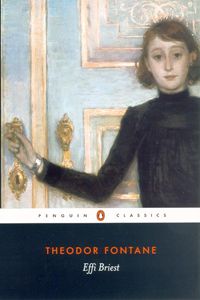
Effi Briest
Effi Briest by Theodor Fontane
Translated by Douglas Parmee
Penguin, 1989/Originally 1895
267 pages
Classic
4/5 stars
Source: Bought
I guess kind of spoilers but the book's over 100 years old so I'm not sure it really matters.
Summary: Effi Briest is a young Prussian aristocratic girl who makes a smart match with Baron Geert von Instetten. But Geert is didactic and doesn't treat Effi as she might wish. Thus she has an affair. Six years later, he discovers her indiscretion and duels her lover. Additionally he divorces her and she ends up dying at the age of 29.
Thoughts: I read this for a class and as I was doing research was surprised to find that it is kind of considered part of an adultery trilogy with the far more famous (although I haven't read them yet) Madame Bovary and Anna Karenina. I had never heard of it until it was assigned but Thomas Mann has considered it one of the greatest six books. I'm not sure if I concur but it was a pretty good read.
We read it because of its observations about the stratified nature of Prussian society. While it is technically unified Germany (post 1871), the main characters are all Prussian aristocrats who live their lives of privilege rather separately from the rising bourgeoisie and certainly from the peasants and workers.
Effi is a sweet girl. She's 16/17 when we first meet her and her husband Geert is 38 and was kind of a boyfriend of her mother's-ew! But she accepts this as an appropriate match, rejecting the bourgeois notion of marriage for love. He treats her like a child but they are mostly happy excepting the affair.
The thing about the affair is that if you didn't know what this book is about, it's a revelation that she had an affair. It's incredibly subtle to modern readers (or at least most of the people in my class including my professor the first time he read it). She goes off in the woods alone and we never really see the couple interacting. I mentioned that her husband discovers letters six years later; first Effi is an idiot for not burning the letters but second it's important that it was more than five years because that's the end of the statute of limitations. That's right, if a woman committed adultery and her husband found out within five years, he could prosecute her. Note male adultery was not even a misdemeanor. While he cannot legally take action, he still has internalized aristocratic notions of honor and thus challenges her aristocratic lover. If the lover hadn't been an aristocrat, then he could not have given satisfaction to Geert.
After the affair, she lives alone without her daughter who Geert turns against her (heartbreaking!) Then she returns home to her parents where she eventually dies. Speaking of her parents, Parmee in the introduction mentions that some of their scenes could almost come out of Jane Austen; I approve of that statement and enjoyed reading those parts because of that.
Overall: Rather good; important historically but that doesn't mean it's not enjoyable.
Recommendations: I would definitely recommend this if you've read Madame Bovary and/or Anna Karenina so that you can tell me about similarities and differences between them. Also if you're interested in reading more German literature. I really only know Goethe but I would like to read more.
Sorry this was so long but thank you for reading or even skimming it. I actually have still more to say and would love to talk about it with you if you've read it. My email is on the side and in my profile.

Translated by Douglas Parmee
Penguin, 1989/Originally 1895
267 pages
Classic
4/5 stars
Source: Bought
I guess kind of spoilers but the book's over 100 years old so I'm not sure it really matters.
Summary: Effi Briest is a young Prussian aristocratic girl who makes a smart match with Baron Geert von Instetten. But Geert is didactic and doesn't treat Effi as she might wish. Thus she has an affair. Six years later, he discovers her indiscretion and duels her lover. Additionally he divorces her and she ends up dying at the age of 29.
Thoughts: I read this for a class and as I was doing research was surprised to find that it is kind of considered part of an adultery trilogy with the far more famous (although I haven't read them yet) Madame Bovary and Anna Karenina. I had never heard of it until it was assigned but Thomas Mann has considered it one of the greatest six books. I'm not sure if I concur but it was a pretty good read.
We read it because of its observations about the stratified nature of Prussian society. While it is technically unified Germany (post 1871), the main characters are all Prussian aristocrats who live their lives of privilege rather separately from the rising bourgeoisie and certainly from the peasants and workers.
Effi is a sweet girl. She's 16/17 when we first meet her and her husband Geert is 38 and was kind of a boyfriend of her mother's-ew! But she accepts this as an appropriate match, rejecting the bourgeois notion of marriage for love. He treats her like a child but they are mostly happy excepting the affair.
The thing about the affair is that if you didn't know what this book is about, it's a revelation that she had an affair. It's incredibly subtle to modern readers (or at least most of the people in my class including my professor the first time he read it). She goes off in the woods alone and we never really see the couple interacting. I mentioned that her husband discovers letters six years later; first Effi is an idiot for not burning the letters but second it's important that it was more than five years because that's the end of the statute of limitations. That's right, if a woman committed adultery and her husband found out within five years, he could prosecute her. Note male adultery was not even a misdemeanor. While he cannot legally take action, he still has internalized aristocratic notions of honor and thus challenges her aristocratic lover. If the lover hadn't been an aristocrat, then he could not have given satisfaction to Geert.
After the affair, she lives alone without her daughter who Geert turns against her (heartbreaking!) Then she returns home to her parents where she eventually dies. Speaking of her parents, Parmee in the introduction mentions that some of their scenes could almost come out of Jane Austen; I approve of that statement and enjoyed reading those parts because of that.
Overall: Rather good; important historically but that doesn't mean it's not enjoyable.
Recommendations: I would definitely recommend this if you've read Madame Bovary and/or Anna Karenina so that you can tell me about similarities and differences between them. Also if you're interested in reading more German literature. I really only know Goethe but I would like to read more.
Sorry this was so long but thank you for reading or even skimming it. I actually have still more to say and would love to talk about it with you if you've read it. My email is on the side and in my profile.
Saturday, October 9, 2010
The Sorrows of Young Werther
The Sorrows of Young Werther by Johann Wolfgang von Goethe
Translated Michael Hulse
Penguin, 1989
Originally published 1774
134 pages
Classic
3/5 stars
Source: Bought for class
Summary: A young man kills himself after being disappointed in love.
Thoughts: I thought this was so boring. I kept falling asleep while I was reading it. The most interesting part was the introduction which explained how part one of the book is based on a real-life experience for Goethe and part two is based on a case where a man killed himself for love.
I think I struggled against his ideal of female perfection, which includes a woman who is acting like a mother to her siblings after the death of their mother (reminded me of Bleak House) and just sounds really boring. The language was a bit too flowery and I didn't sympathize with Werther falling for a woman who clearly states that she is already involved with another man.
Overall: A short classic that you could read fairly quickly but not my taste at all!
Cover: This isn't my cover as I have an earlier Penguin edition but it fits.
Translated Michael Hulse
Penguin, 1989
Originally published 1774
134 pages
Classic
3/5 stars
Source: Bought for class
Summary: A young man kills himself after being disappointed in love.
Thoughts: I thought this was so boring. I kept falling asleep while I was reading it. The most interesting part was the introduction which explained how part one of the book is based on a real-life experience for Goethe and part two is based on a case where a man killed himself for love.
I think I struggled against his ideal of female perfection, which includes a woman who is acting like a mother to her siblings after the death of their mother (reminded me of Bleak House) and just sounds really boring. The language was a bit too flowery and I didn't sympathize with Werther falling for a woman who clearly states that she is already involved with another man.
Overall: A short classic that you could read fairly quickly but not my taste at all!
Cover: This isn't my cover as I have an earlier Penguin edition but it fits.
Sunday, February 28, 2010
Becoming Jane Eyre
Penguin Books, 2009; 232 pages
Summary: An examination into the lives of the Brontës as Charlotte embarks on writing her most famous novel, Jane Eyre. Starts in 1846 and continues until her death in 1855.
Why I Read: I saw this reviewed at Laura's Reviews and I put it on hold at the library; I also knew I would count it toward the Brontë challenge. I am a big Janeite but I am trying to learn more about the Brontës.
My thoughts: It's a slight book is my lasting impression. It is also somewhat disconcerting in that it is told in shifting third person; so it starts with Charlotte's point of view but it also shifts to her sisters', her father's and some other people's points of view. I enjoyed finding the connections from her life to Jane Eyre (the only Brontë book I've read all the way through). They also seemed a bit more real to me; I've had trouble with the other Brontë books because they just seem so dour and written by people completely lacking a sense of humor. That idea is not completely dispelled by this book but they do seem a pretty progressive family and I liked seeing them sitting together and reading their work aloud to each other. On the other hand, I am more interested in picking up Agnes Grey and giving that a try now so I think the book is good for that purpose.
Overall: 3.5/5 for encouraging me to read more Brontë but not a book I would necessarily recommend unless it was to a diehard Brontë fan.
Subscribe to:
Posts (Atom)